
Andrii Bashtovyi, chief editor of The Village, speaks about volunteering, exploring life and death in the war through a camera lens, and his mobilization to the military.
Listen
First days of the war - thoughts, experiences, actions


Read
For Andrii Bashtovyi, the full-scale war began in the afternoon of February 24.
He was sitting by the pool in sunny Bali. After yoga and swimming, he opened the newsfeed and saw that Russian missiles had been launched at Ukraine. Right until the very last moment, he couldn’t believe that anything like that would happen.
Andrii switched his laptop on. Two of his colleagues from The Village were already wide awake. Together they started a night news shift. As other journalists woke up over the next several hours, they took over, whilst Andrii quickly packed his suitcase and rushed to the airport. The flights had been delayed: he missed his transfer to Istanbul, and his friends changed the tickets for him in real time. Andrii spent the next night in Jakarta updating the news feed again, then took a flight to Istanbul, transferred to Budapest, and finally took a car to the Ukrainian border. He never considered the option of staying abroad: this would have been unacceptable for him as either a journalist or a son, or a Ukrainian citizen.
"There was a colossal queue to leave Ukraine, while my car was the only one entering from the Hungarian side,” Andrii recalls. “I had no warm clothes at all. My friends met me when I got across the border. On our way to Lviv, we sometimes stopped and gave the children sweets. That seemed surreal.”
Back in Ukraine, Andrii wrote the news at night and helped the military as a volunteer in daytime: he supplied them with water and food, delivered ‘Czech hedgehogs’, body armor or helmets to their positions, and so on.
“That was very chaotic, because we had no experience in regular volunteering,” says Andrii. “Later, it became clear that we had to switch from ‘leap’ to ‘sprint’ mode, and then to ‘marathon’.”
The team of The Village decided on how to work. The city of Kyiv had once been well-developed and full of stylish facilities, yet now it was war that dominated everywhere. So, this was what they wrote about. They focused on simple guidance, calls to action, and human stories. A few ex-colleagues rejoined the team in the first month to help them withstand the pace of the clock work on a pro bono basis. First and foremost, they were updating the Normal News Telegram channel, and they could hardly find the time to post anything on the website.
“We just worked day and night,” Andrii explains. “We had to inform people but avoid getting burned out. You can hold out without sleep for a week maximum, not four months. So we had to restrain the intensity of our work. Sometimes I forced my colleagues to go to sleep if they worked too much, and that really helped.”
Some Russian acquaintances wrote to Andrii in the first days of the full-scale war: they said were very sorry about what was going on and insisted that they had nothing to do with it. However, he was totally indifferent to these pleas for understanding.
“I honestly don’t care whether they are sorry or not,” says Andrii. “If they really are, let them do something about their own country so that it doesn’t attack others. I’m not even interested in their feelings as a journalist: there are much more relevant issues to cover. I only wish them to leave us alone. What we are witnessing now is the collapse of the empire. It’s dying, agonizing, releasing toxic putrid gases, and trying to drag us down into the deep too. Our challenge is to stand against it, because this huge machinery still has plenty of resources available.”
Andrii had a chance to see how the Chernihiv, Kharkiv, Sumy, Donetsk, and Zaporizhzhia regions were standing up to the threat firsthand, as he made a number of reports and photo excursions for foreign media. He was quite astonished to witness Chernihiv, Sumy and Okhtyrka still resisting, even though from a distance it seemed as if these cities had been already razed to the ground. He thrilled to see the destroyed Russian columns, and reveled in the attitudes of the local authorities who had not left their regions and communities, but defended their dear country shoulder to shoulder with the people. He helped to raise funds to reconstruct the villages near Chernihiv. He was happy to see old ladies in the Zaporizhzhia region who were still planting their gardens against all odds. He had never been afraid of shelling, yet now he feels like the fear will seize him sometime later.
“My camera is a very helpful emotional filter for me,” says Andrii. “For instance, once in Severodonetsk I was filming people who were hiding in a bomb shelter. They were really serious about it. I filmed an old woman taking her even older mother downstairs, and my hands didn’t even tremble. I wasn’t reflecting on what was going on: I was just thinking of doing my job. This is how stay focused on my job, although on the other hand, I can blow a gasket after a while. I haven’t still accepted what has happened to Bucha, even though I’d filmed there too. Maybe I’m way too aesthetic, but I felt like I was watching a movie.”
This cinematic feeling didn’t leave till Andrii joined the military himself.

He had been in touch with his military administration in the city of Cherkasy since 2015: given regular medical checkups, received training, and prepared to command a territorial defense unit. On the day he was called for his latest medical checkup, Andrii was filming in Kharkiv for the Economist. Two weeks later in Kyiv he got another call and was summoned for training; it was expected to last for six weeks, but ended up reduced to just four. His military specialty was changed too. Andrii had initially studied repair and maintenance of aviation weapons at the military department of the National Aviation University, but changed his mind later during training ‒ in fact, just as he was leaving the training ground.
“The last one is the most dynamic and cheerful,” Andrii laughs. “It’s in my personal all-time top three. When the command told us our mission and destination, all the guys were like, ‘Wow, no way!’ while I went to google the unknown abbreviations. I laughed ironically when I finally understood what that was all about, because I’m 64 kg of pure anger, wrath, and death to the occupiers.”
Andrii feels no fear, just eagerness. He’s talking on the eve of his departure to the frontline, where he is going to be a squad commander. He isn’t still accustomed to it but already knows that withdrawal is not an option. He is getting used to jokes about the war, and to meeting outstanding people among his brothers in combat, whom he wants to immortalize in his photo portraits. He’s proud of his military trainers who have gone through real military operations and are completely devoid of the Soviet mindset. They all deserve to be subjects of biopics, and Andrii has the honor to follow them to the forefront.
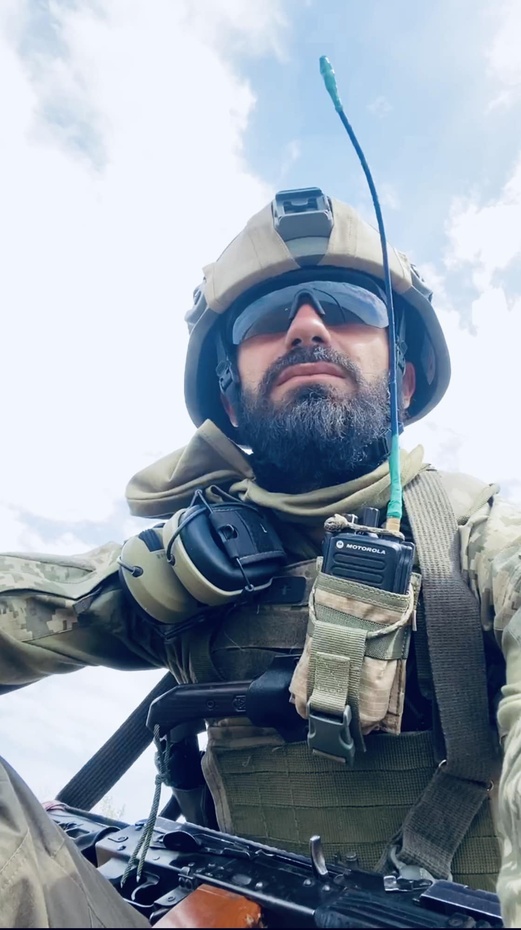
He is still somewhat embarrassed about being a squad commander. It’s not as if he has been thoroughly selected to this position according to his skills: it’s sheer chance. Andrii honestly admits that he does not know much yet. He’s never chosen a flank for a machine gunner, dug a trench, experienced an artillery shelling, given a combat order, arranged installation of an engineering fence, asked for artillery support, or requested help for the military aviation. He has no idea how he would react to all these things.
Yet even now Andrii has his camera with him. Otherwise, he wouldn’t be ready to go through the trials to come.

“It’s not death which is interesting in time of war, but life,” Andrii ponders. “Death is something that just happens. Of course, you have to be helpful, grateful, appreciative, and attentive to the grief of others. But all the best war stories are primarily about life. While other reporters were wandering across the war-torn regions to see death and devastation, I just saw life. The main thing is not to get stale, not to start saying, like, it has already happened somewhere else, not to equate everything to Bucha or Mariupol. Every broken fence of any old lady's house is important. Every crime, even the smallest, must be documented, and those responsible brought to justice if the Ukrainian military doesn’t get them first. This is our responsibility as journalists. If justice is not restored, injustice will repeat over and over again.”


